

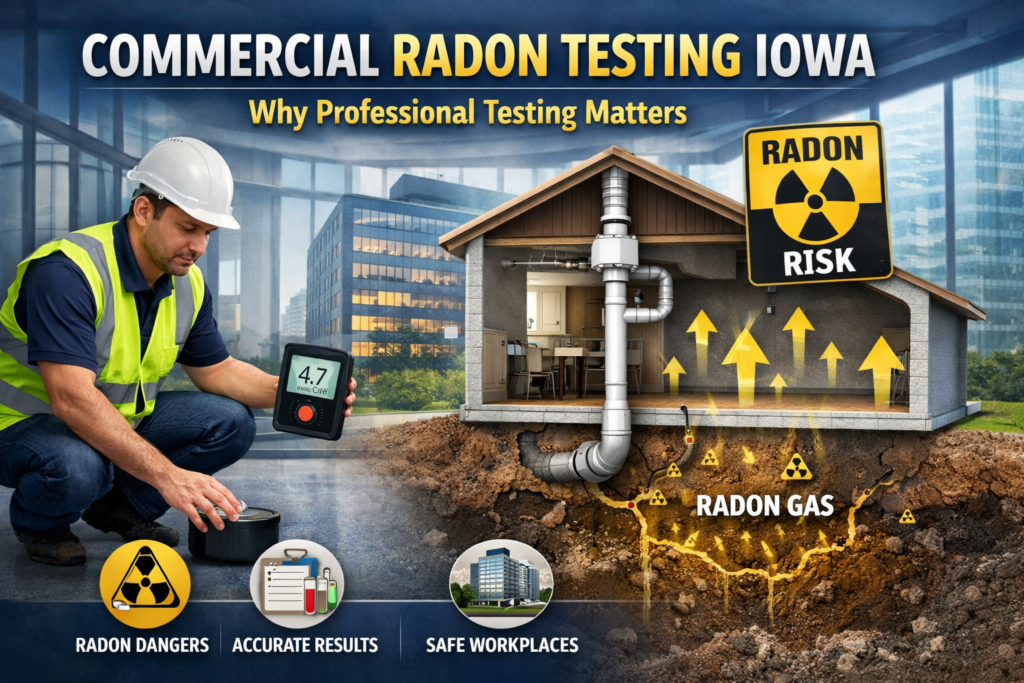
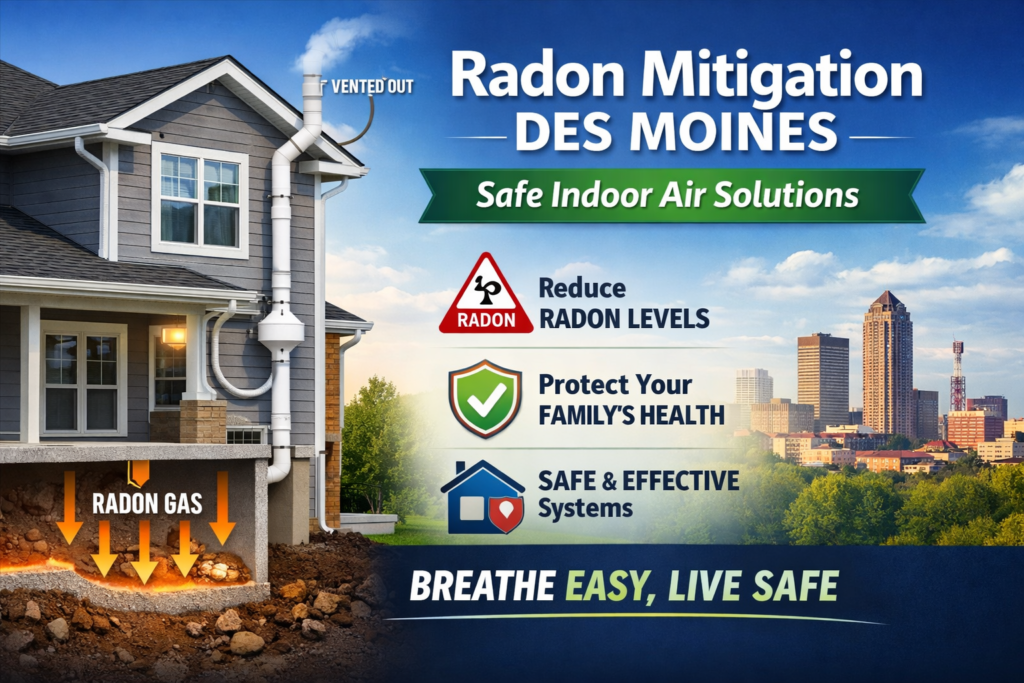
Iowa radon concerns start underground, yet indoor results drive real decisions. Moreover, Iowa’s soil layers and glacial deposits often create easy pathways for soil gas, so radon can travel toward foundations faster than many homeowners expect. Additionally, pressure differences inside basements and crawlspaces can pull that gas indoors through small openings, so the risk can rise even in well-maintained buildings. This guide explains why Iowa geology produces high radon and shows how a simple testing-and-fix workflow protects homes, schools, and workplaces.

What Radon Is and Why Iowa Shows Higher Potential
Radon is a naturally occurring gas that forms underground when uranium in soil and rock breaks down. Because it has no smell, color, or taste, people cannot detect it without testing. Moreover, radon can move through soil pores and small fractures, so it can travel toward buildings and enter through tiny foundation gaps. Therefore, the only way to know the indoor level is to measure it with a properly placed test.
Iowa often shows higher radon potential because its ground conditions can support both steady radon production and efficient gas movement. Additionally, mixed soil layers and porous pathways can guide soil gas toward foundations, especially around basements and below-grade spaces. Consequently, indoor levels can rise even in well-maintained buildings when indoor pressure pulls air from lower levels.
Iowa’s Glacial History and Radon-Friendly Soils
Iowa’s glaciers shaped soil layers that let radon move and collect more easily beneath buildings, causing these problems:
- Layered Soils Create Pathways: Glacial layers mix sand, silt, and clay. Therefore, radon follows easier routes toward foundations.
- Loose Backfill Pulls Gas In: Backfill stays less compact near walls. Consequently, soil gas gathers and enters through small gaps.
- Pockets Create Neighborhood Hotspots: Soils change fast across short distances. As a result, nearby homes can show different readings.
- Moisture Shifts Reroute Gas: Wet and dry cycles change soil pores. Therefore, radon pathways and indoor levels can shift.
These glacial soil effects explain why Iowa often needs testing and verified next steps instead of assumptions.
Loess and Till Layers: How They Affect Soil Gas Flow
Loess and till layers influence how soil gas moves beneath buildings. These often consists of fine, wind-deposited material that can hold together while still allowing air to pass through connected pores. Therefore, radon can migrate laterally through these layers until it finds a pressure pathway toward a foundation. In many areas, loess sits near the surface, so gas movement can occur close to basements and slabs.
Till layers, by contrast, include a dense mix of clay, sand, gravel, and stones left by glacial activity. Consequently, till can slow vertical gas movement in some spots while redirecting it sideways into more permeable zones. When a foundation cuts through these layers, pressure differences can draw redirected soil gas upward. As a result, the interaction between loess and till often concentrates radon flow near structures rather than dispersing it evenly underground.
The Most Common Entry Points of Iowa Homes
Small openings often let soil gas enter even when a home looks sealed. Therefore, identifying these common routes helps you test smarter and fix faster.
A) Sump Pits and Lids
Sump pits often connect directly to the soil beneath the home and slab. Therefore, loose lids or missing gaskets let soil gas rise into the basement air. As a result, radon can enter steadily, even when the rest of the floor looks intact.
B) Floor-Wall Joints
Floor-wall joints run along the full basement perimeter where two surfaces meet. Consequently, tiny gaps at this seam can pull soil gas when indoor pressure drops. Over time, that continuous airflow through the joint can lift indoor radon readings.
C) Shrinkage Cracks
Concrete naturally shrinks as it cures, and it can crack as the building settles. Therefore, hairline cracks can appear in slabs or walls without any major visible damage. These cracks still create direct pathways that move soil gas into the living space.
D) Utility Penetrations
Pipes, conduits, and drains pass through foundation walls and floor slabs at multiple points. As a result, imperfect sealing around penetrations leaves hidden gaps behind finishes or coverings. Radon can move through these openings whenever pressure favors entry, especially during colder months.
E) Crawlspace Seams
Crawlspaces often include exposed soil, liner seams, and edge gaps near support piers. Consequently, openings at seams let soil gas collect under the floor and spread across the crawlspace. Radon then moves upward through small leaks and pressure flow into occupied rooms above.
These routes explain why sealing alone rarely solves the entire issue. Therefore, testing and verified mitigation provide the most reliable protection. Learn more about Radon Health Risk in Iowa Homes.
What “High Radon Potential” Means for Homeowners
High radon potential means the ground can feed radon into a home, so owners should plan for proof, not assumptions.
1. Testing Becomes a Routine Step — A proper test confirms the real indoor level for that specific home.
2. Basements Need Extra Attention — The lowest level often shows higher readings because it sits closest to soil gas
3. Seasonal Swings Stay Normal — Winter conditions can raise levels, so timing can influence short tests.
4. Fixes Must Be Verified — A follow-up test proves the reduction after any mitigation work.
High potential signals a need for consistent testing and verified next steps, not fear or guesswork.

Conclusion
Iowa’s subsurface conditions can generate radon continuously, and soil pathways can move that gas efficiently. Therefore, when someone asks why Iowa geology produces high radon, the most useful answer stays practical: test correctly, document results, and use verified mitigation when readings come back elevated. DSM Radon appears in the final step of the process by helping connect clear information with confident decisions. Moreover, consistent testing matters because radon levels can vary by season, weather, and building pressure changes. As a result, a clear test-and-fix plan protects indoor air quality without guesswork or delay.