
Choosing the right air purification system for your home depends on three factors: your home’s size, your primary air quality concern, and whether you rent or own. Portable units handle single rooms effectively, whole-home HVAC-integrated systems cover every square foot, and in-duct UV purifiers target pathogens at the source. Matching the system type to your specific scenario is the fastest path to cleaner indoor air.
The Three Main Types of Home Air Purification Systems
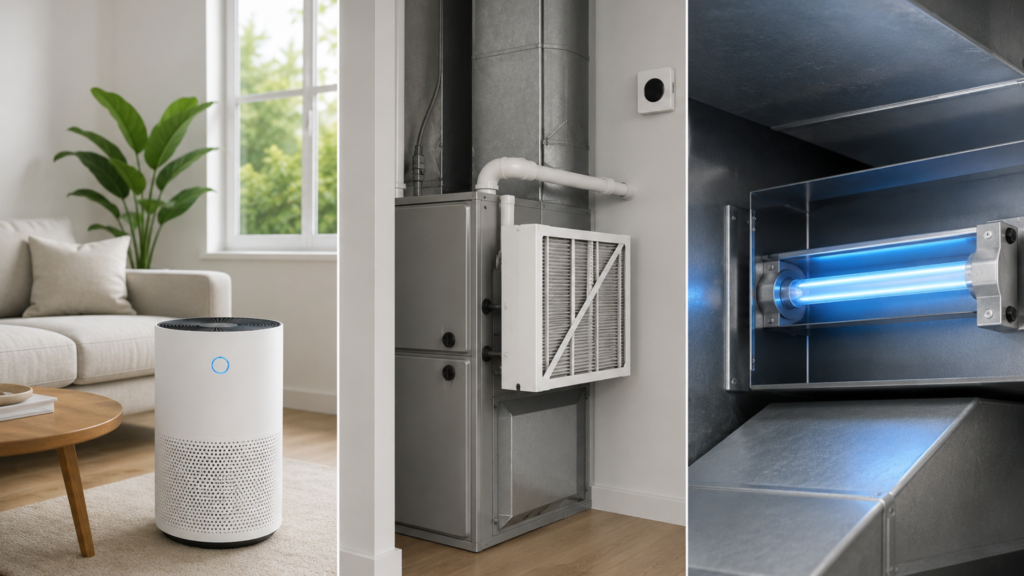
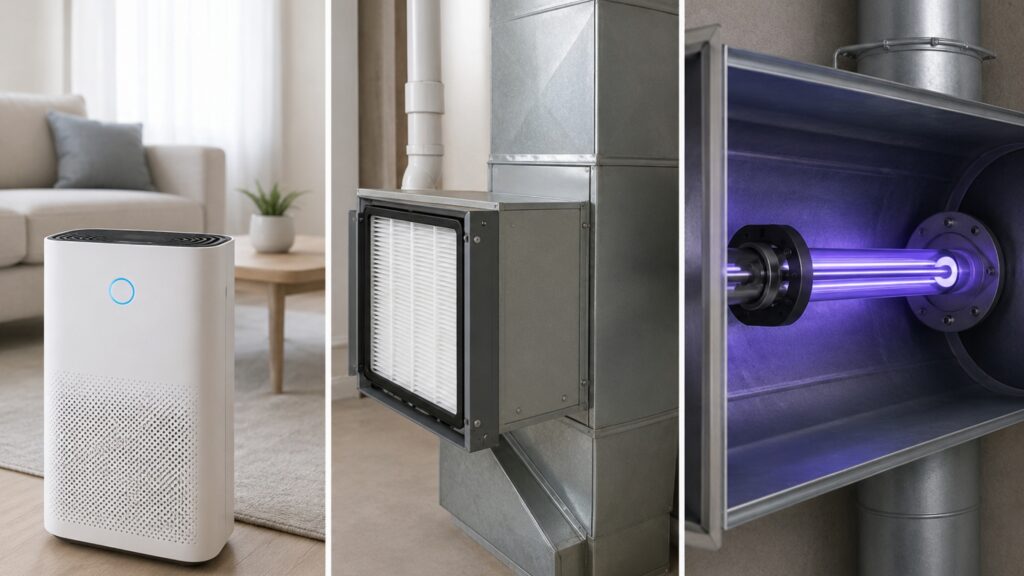
Home air purification systems fall into three distinct categories: portable air purifiers, whole-home central air purifiers integrated with your HVAC system, and in-duct UV air purifiers. Each type uses different technology, covers different square footage, and carries a different price tag. Understanding these distinctions upfront prevents costly mismatches between the product you buy and the problem you’re trying to solve.
1. Portable Air Purifiers: Best for Single-Room Coverage
A portable air purifier is a self-contained unit you plug into a standard outlet and move between rooms. Most use a HEPA filter to capture particles, and their performance is measured by two key metrics: CADR (Clean Air Delivery Rate) and ACH (Air Changes per Hour). CADR measures how many cubic feet of clean air the unit delivers per minute for smoke, dust, and pollen. ACH measures how many times per hour the unit cycles all the air in a given room.
Yes, home air purifiers work when matched to room size and pollutant type. HEPA-based units remove 99.97% of particles 0.3 microns or larger, including dust, pollen, and pet dander. Effectiveness depends on CADR rating relative to room square footage and maintaining at least 4–5 air changes per hour.
Portable units are the right choice for renters, small apartments, or targeted problem areas like a bedroom or home office. They are the wrong choice if you need whole-home coverage — running five portable units costs more over time than a single integrated system. Independent lab testing published by HouseFresh confirms that high-CADR portable units perform as advertised, but only within their rated square footage.
2. Whole-Home Central Air Purifiers: HVAC-Integrated Filtration
A whole-home air purifier attaches directly to your existing HVAC system and filters air as it circulates through your ductwork. Brands like AprilAire, Amaircare, and Allerair manufacture units that install between the return air duct and the air handler. Because every cubic foot of conditioned air passes through the filter, a single system protects your entire home simultaneously.
AprilAire’s whole-home purifier line uses high-efficiency media filters with MERV ratings between 11 and 16, capturing particles as small as 0.3 microns without restricting airflow. Installation requires a licensed HVAC technician and typically takes two to four hours. The cost-per-square-foot efficiency of whole-home systems is significantly better than running multiple portable units across a large house.
Whole-home systems also address VOCs (volatile organic compounds) more effectively than standard portable units when equipped with activated carbon stages. This matters for homeowners dealing with off-gassing from new furniture, paint, or flooring.
3. In-Duct UV Air Purifiers: Germicidal Technology Explained
In-duct UV purifiers mount inside your ductwork and use UV-C germicidal irradiation — and in some models, ionized hydro-peroxide technology — to neutralize bacteria, mold spores, and viruses before they circulate through your home. The Reme HALO is one of the most widely installed models in this category. The Air Health in-duct purifier is another option that specifically markets an ozone-free design.
Ozone is a legitimate concern with some ionization-based systems. A Mayo Clinic community discussion flags that certain whole-house ionizers produce ozone as a byproduct, which can irritate the lungs at elevated concentrations. Shoppers should verify that any in-duct system carries a California Air Resources Board (CARB) certification, which limits ozone output to 0.050 parts per million. UV-C-only systems that do not use ionization produce no ozone at all.
In-duct UV purifiers work best as a complement to mechanical filtration, not a replacement. They excel at pathogen control but do not capture particulate matter the way a HEPA filter does. According to Trane’s residential glossary, combining UV germicidal technology with a high-MERV media filter delivers the broadest spectrum of protection.
Side-by-Side Comparison: Cost, Coverage, and Effectiveness
| Feature | Portable Purifier | Whole-Home (HVAC) | In-Duct UV |
|---|---|---|---|
| Upfront cost | $100–$800 | $500–$3,000+ installed | $500–$2,500 installed |
| Coverage | 150–1,500 sq ft per unit | Entire home | Entire duct system |
| Filter replacement | $30–$150/year | $50–$200/year | Lamp: $100–$300 every 2 years |
| Filtration efficiency | HEPA: 99.97% at 0.3 µm | MERV 11–16 | UV-C: targets pathogens |
| Targets particles? | Yes | Yes | No (needs paired filter) |
| Targets pathogens? | Limited | Limited | Yes |
| Targets VOCs? | With carbon stage | With carbon stage | No |
| Installation | Plug-in, DIY | Professional required | Professional required |
| Ozone risk? | Low | Low | Verify CARB certification |
Consumer Reports’ air purifier buying guide recommends evaluating total cost of ownership — including filter replacements — over a five-year period before comparing sticker prices.
How to Choose the Right System for Your Home
The best air purification system for a home is the one matched to your specific living situation, not the one with the highest price or the most features. Use these scenarios to self-select:
- Renters or apartment dwellers: Choose a portable HEPA purifier with a CADR of at least 200 for bedrooms and 300+ for living areas.
- Homeowners with allergies or asthma: A whole-home HVAC-integrated system with a MERV 13 filter provides consistent, room-to-room protection. See our guide to best air purifiers for allergies and asthma for specific product recommendations.
- COPD patients: The American Lung Association recommends HEPA filtration combined with low-VOC indoor environments. A whole-home system with an activated carbon stage is the strongest option.
- Pet owners: Portable high-CADR units near pet areas, combined with a whole-home MERV 11+ filter, address both dander and odor.
- Homeowners concerned about viruses and mold: Pair a whole-home media filter with an in-duct UV system like the Reme HALO for layered protection.
Start With an Indoor Air Quality Assessment
If you are unsure where your indoor air quality stands today, start with how to test your home’s indoor air quality before investing in any system. Understanding your specific pollutants and problem areas helps you choose the most effective purification solution and avoid unnecessary expenses.
Key Specs to Check Before You Buy: CADR, MERV, and ACH
CADR (Clean Air Delivery Rate) is measured in cubic feet per minute (CFM) and tells you how fast a unit cleans the air of smoke, dust, and pollen. The Association of Home Appliance Manufacturers (AHAM) sets CADR standards. As a rule of thumb, your CADR number should be at least two-thirds of your room’s square footage — so a 300 sq ft room needs a CADR of at least 200.
MERV rating (Minimum Efficiency Reporting Value) applies to HVAC filters and runs from 1 to 16 for residential use. MERV 8 captures large particles like dust and pollen. MERV 13 captures fine particles including smoke and some bacteria. For deeper context on filter grades, see our understanding MERV ratings for HVAC filters guide.
ACH (Air Changes per Hour) tells you how many times per hour the purifier cycles all the air in a room. For allergy and asthma sufferers, target a minimum of 4 ACH. For COPD patients or immunocompromised individuals, 5–6 ACH is preferable. Divide the unit’s CFM by the room’s cubic footage and multiply by 60 to calculate ACH manually.
Installation: DIY Portable vs. Professional HVAC Integration
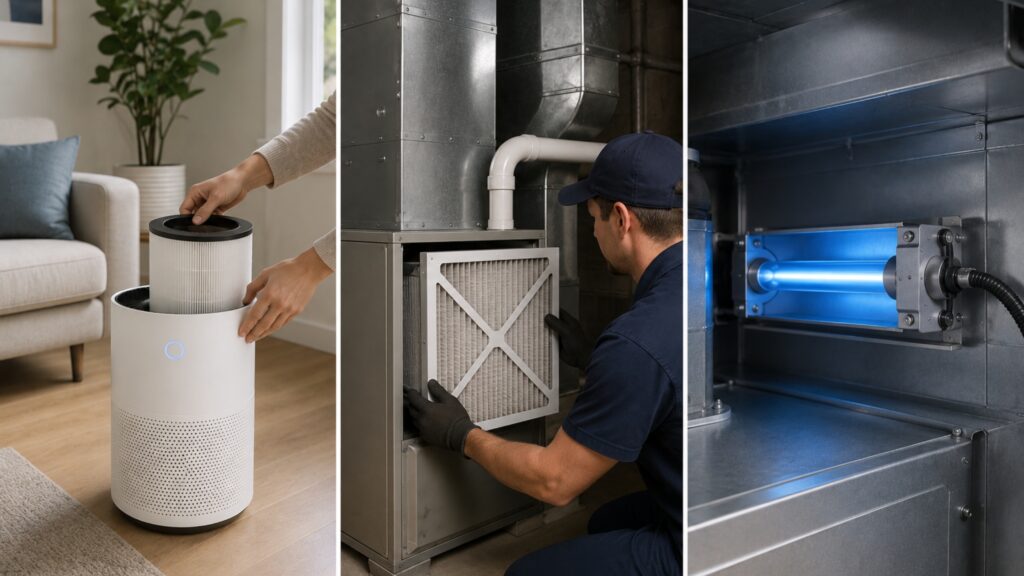
Portable air purifiers require zero installation. Unbox the unit, insert the filter, plug it in, and position it at least 18 inches from walls for optimal airflow. The total setup time is under five minutes. This is the primary practical advantage of portable units for renters or homeowners who want immediate results.
Whole-home HVAC-integrated systems require a licensed HVAC technician. The technician cuts an opening in the return air plenum, mounts the filter housing, and connects it to the existing ductwork. Labor typically adds $200–$600 to the equipment cost, and the job takes two to four hours. Most manufacturers, including AprilAire, require professional installation to maintain the product warranty.
In-duct UV systems follow a similar process. The technician mounts the UV lamp assembly inside the supply plenum, near the air handler coil. Electrical connection to a nearby circuit is required. Total installed cost for a Reme HALO or comparable system typically runs $800–$2,000 depending on your market and HVAC configuration. Both whole-home and in-duct systems benefit from annual HVAC maintenance visits to inspect filter condition and UV lamp output.
FAQs
1. Do home air purifiers really work?
Yes, home air purifiers work when matched to room size and pollutant type. HEPA-based units remove 99.97% of particles 0.3 microns or larger, including dust, pollen, mold spores, and pet dander. Effectiveness depends on CADR rating relative to room square footage and maintaining at least 4–5 air changes per hour. Undersized units or incorrect placement significantly reduce real-world results.
2. What is the best air purification system for a home?
The best system depends on your home size, ownership status, and primary concern. Whole-home HVAC-integrated systems with MERV 13 filters offer the broadest coverage for homeowners. Portable HEPA purifiers with a CADR above 200 are the top choice for renters or single-room needs. Combining a whole-home media filter with an in-duct UV system provides the highest level of overall protection.
3. What is the difference between a portable and a whole-home air purifier?
A portable air purifier is a standalone plug-in unit that cleans air in one room at a time. A whole-home air purifier integrates with your HVAC system and filters air throughout your entire house as it circulates through the ductwork. Portable units cost less upfront but require multiple units for full-home coverage. Whole-home systems require professional installation but deliver consistent, house-wide filtration.
4. How much does a whole-home air purification system cost to install?
A whole-home HVAC-integrated air purification system typically costs $700–$3,600 fully installed, including equipment and labor. Equipment alone ranges from $500 to $3,000 depending on the brand and filtration level. Professional installation adds $200–$600 in most markets. Annual filter replacement costs run $50–$200 per year depending on the MERV grade and filter size.
5. Do in-duct UV air purifiers produce ozone?
Some in-duct UV systems that use ionized hydro-peroxide technology produce trace ozone as a byproduct. UV-C-only systems that do not use ionization produce no ozone. Always verify that any in-duct system carries California Air Resources Board (CARB) certification, which limits ozone output to a safe threshold of 0.050 parts per million. The Air Health in-duct purifier specifically markets an ozone-free design.
6. What is the best air purifier for someone with COPD or asthma?
For COPD and asthma patients, a whole-home HVAC system with a MERV 13 filter combined with an activated carbon stage for VOC removal is the strongest option. For single-room use, choose a portable HEPA purifier with a CADR rating that delivers at least 5–6 air changes per hour in your room. Avoid ionizer-based systems that produce ozone, as ozone is a known lung irritant.
7. Do air purifiers help with norovirus or airborne viruses?
Air purifiers can reduce airborne virus concentrations but are not a standalone defense against norovirus or similar pathogens. Norovirus spreads primarily through surface contact and contaminated food, not airborne transmission. For airborne viruses like influenza, HEPA filters capture virus-carrying particles, and in-duct UV-C systems can neutralize pathogens in the airstream. A layered approach — filtration plus UV — provides the best airborne pathogen reduction.
8. What CADR rating do I need for my room size?
Use the two-thirds rule: your CADR should equal at least two-thirds of your room’s square footage. A 150 sq ft bedroom needs a CADR of at least 100. A 300 sq ft living room needs a CADR of at least 200. For allergy or asthma sufferers, size up — target a CADR equal to or greater than the room’s full square footage to achieve 4–5 air changes per hour at realistic ceiling heights.