
Radon mitigation in Des Moines, Iowa typically costs between $800 and $2,500 and involves installing a sub-slab depressurization system that vents radon gas safely outside your home. Polk County sits in EPA Zone 1 — the highest-risk radon classification — making professional mitigation a serious priority for most Des Moines homeowners with test results at or above 4 pCi/L.
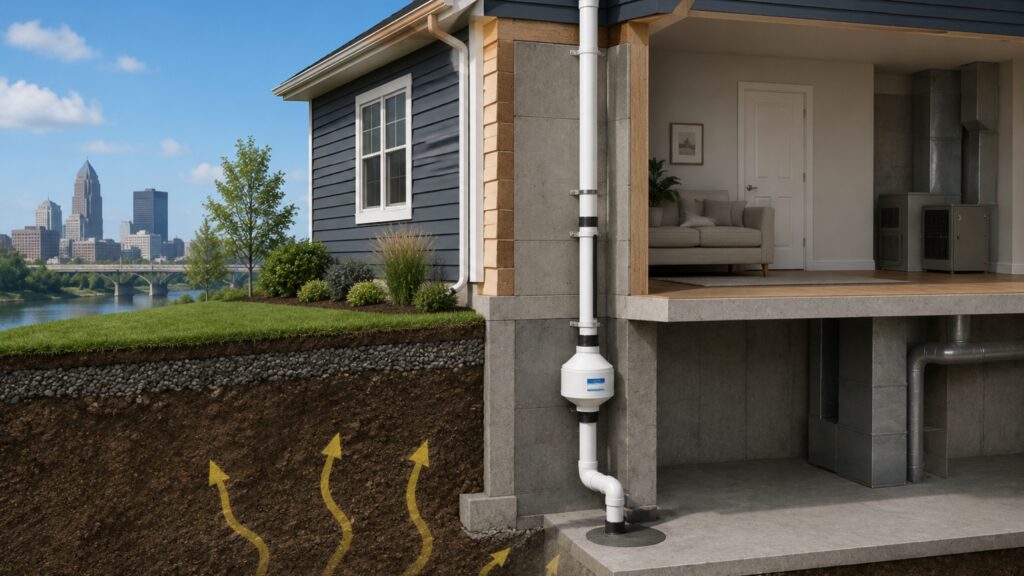
Why Des Moines Homes Face Elevated Radon Risk
Polk County, Iowa carries an EPA Zone 1 designation, meaning the EPA predicts average indoor radon levels above 4 picocuries per liter (pCi/L) — the federal action level. Iowa consistently ranks among the top five states for radon exposure in the U.S., with the Iowa Department of Public Health (IDPH) reporting that approximately 71% of Iowa homes tested exceed the EPA action level. Des Moines sits on glacial till soils that are particularly porous, allowing soil gas — including radon — to migrate easily into building foundations.
Radon is the second leading cause of lung cancer in the United States, responsible for roughly 21,000 deaths per year according to the EPA. If you have not yet tested your home, professional radon testing in Des Moines is the essential first step. You cannot smell, see, or taste radon, which means testing is the only reliable way to know your risk level.
What Is Radon and How Does It Enter Your Home?
Radon gas is a naturally occurring radioactive gas produced by the decay of uranium in soil and rock. It forms as a soil gas underground and seeps upward through cracks in foundations, construction joints, gaps around service pipes, and block wall cavities. Once radon enters a home, it can accumulate to dangerous concentrations — especially in basements and lower levels with limited ventilation.
The EPA action level of 4 pCi/L is the threshold at which mitigation is strongly recommended. Levels between 2 and 4 pCi/L still warrant consideration for mitigation, particularly in Iowa where background levels are elevated statewide. Iowa State University Extension’s Radon Program notes that radon levels can vary significantly from house to house, even on the same street, due to differences in foundation type and soil composition. For a deeper background, see what is radon gas.
Radon Mitigation Methods Used in Des Moines Homes
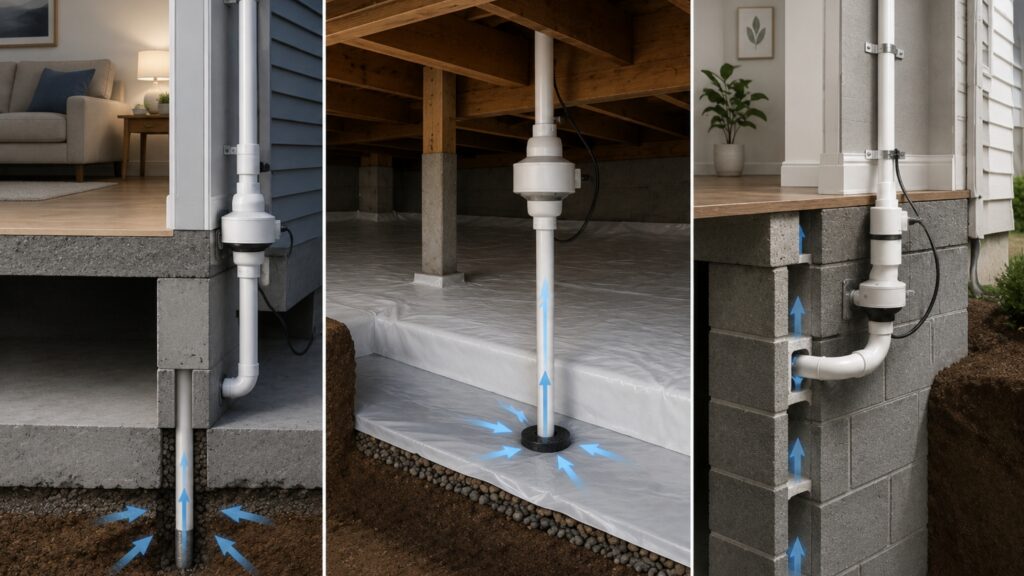
Des Moines homes vary widely in foundation type — poured concrete slabs, concrete block walls, and crawl spaces are all common, particularly in neighborhoods built before 1980. Each foundation type requires a specific mitigation approach. The three primary methods used by Iowa-certified contractors are sub-slab depressurization (SSD), crawl space encapsulation with depressurization, and heat recovery ventilator (HRV) installation.
Radon-resistant new construction (RRNC) techniques are now incorporated into many new Des Moines builds, but older homes require active mitigation systems. A licensed contractor will assess your foundation before recommending the right method.
Sub-Slab Depressurization: The Most Common Iowa Solution
Sub-slab depressurization (SSD) is the most widely used and most effective radon mitigation method in Iowa. A contractor drills one or more suction points through the concrete slab, inserts a PVC pipe, and routes it vertically through the home or along an exterior wall to a point above the roofline. A radon mitigation fan creates negative pressure beneath the slab, drawing soil gas out before it can enter the living space.
In Des Moines homes with poured concrete slab or basement foundations, SSD typically reduces indoor radon levels by 50% to 99%, according to the EPA’s Consumer’s Guide to Radon Reduction. Most installations require only one suction point, though larger or compartmentalized slabs may need two or more. The fan runs continuously and uses roughly the same electricity as a standard light bulb. Post-installation, a post-mitigation radon test confirms the system is working as designed.
Crawl Space and Block Wall Mitigation Options
Older Des Moines homes — particularly those built in the 1940s through 1970s — frequently feature crawl space foundations or hollow concrete block walls, both of which require different mitigation strategies. Crawl space encapsulation involves sealing the crawl space floor with a heavy-duty vapor barrier and installing a depressurization pipe beneath it to vent soil gas outside.
Block wall mitigation targets the hollow cores of concrete block foundations, which act as pathways for radon to travel upward into living areas. A contractor installs suction points directly into the block cores and connects them to a venting system. In some cases, a heat recovery ventilator (HRV) is added to improve overall air exchange, particularly in tightly sealed homes where ventilation is limited. Check Iowa radon levels by county to understand how your neighborhood compares.
Radon Mitigation Cost in Des Moines, Iowa
Radon mitigation in Des Moines, Iowa typically costs between $800 and $2,500, with most homeowners paying around $1,200 for a standard sub-slab depressurization system. Final cost depends on foundation type, number of suction points, and pipe routing complexity. Iowa-certified contractors can provide exact quotes after a site assessment.
Key variables that affect your final price include:
- Foundation type: Poured slabs are the most straightforward. Block foundations and crawl spaces require additional labor and materials.
- Number of suction points: Each additional point adds $200–$400 to the total.
- Pipe routing: Interior routing through finished living space costs more than exterior pipe runs.
- Fan grade: Heavy-duty fans for larger homes or highly permeable soils cost more than standard units.
- Post-mitigation testing: Most contractors include a follow-up test; confirm this before signing a contract.
For a full breakdown of what drives pricing, see the radon mitigation cost breakdown. Radon mitigation is a one-time installation with annual electricity costs typically under $30, making it a highly cost-effective investment relative to long-term health risk.
How to Choose a Certified Radon Contractor in Iowa
Iowa does not legally require radon contractor licensing, but the Iowa Department of Public Health (IDPH) strongly recommends — and most reputable contractors hold — certification through the National Radon Proficiency Program (NRPP) or the National Radon Safety Board (NRSB). These credentials require passing a national exam, completing continuing education, and adhering to EPA mitigation standards.
Use this five-point checklist when vetting a contractor:
- Verify NRPP or NRSB certification at nrpp.info before scheduling an estimate.
- Confirm IDPH recognition: Check the IDPH radon page for any state-specific contractor listings or advisories.
- Request a written quote that itemizes labor, materials, fan warranty, and post-mitigation testing.
- Ask about fan warranty: Quality radon mitigation fans typically carry 3–5 year warranties; some manufacturers offer longer coverage.
- Check references and reviews from Des Moines-area homeowners specifically — local experience with Iowa foundation types matters.
Avoid any contractor who quotes a job without conducting an in-person site assessment. Foundation conditions vary too much for accurate remote estimates. Browse certified radon contractors in Iowa to start your search.
What to Expect During and After Mitigation
A standard radon mitigation installation in a Des Moines home takes approximately four to eight hours and is typically completed in a single day. The contractor drills the suction point(s), installs the PVC pipe system, mounts the radon mitigation fan, seals all penetrations, and tests the system’s suction pressure before leaving.
You can remain in your home during installation. The contractor will explain the system, show you the diagnostic gauge (a U-tube manometer), and confirm the fan is operating correctly. Noise from the fan is minimal — comparable to a bathroom exhaust fan running in another room. Most reputable contractors provide a system diagram and warranty documentation at completion.
After installation, you must conduct a post-mitigation radon test to verify results. The EPA recommends waiting at least 24 hours after installation before placing a test device. Most Iowa contractors recommend a 48-hour short-term test as the fastest way to confirm the system is working. If results still exceed 4 pCi/L, the contractor should return to adjust suction points or fan capacity at no additional charge — confirm this guarantee in writing before work begins.
Iowa Radon Testing: Before and After Mitigation
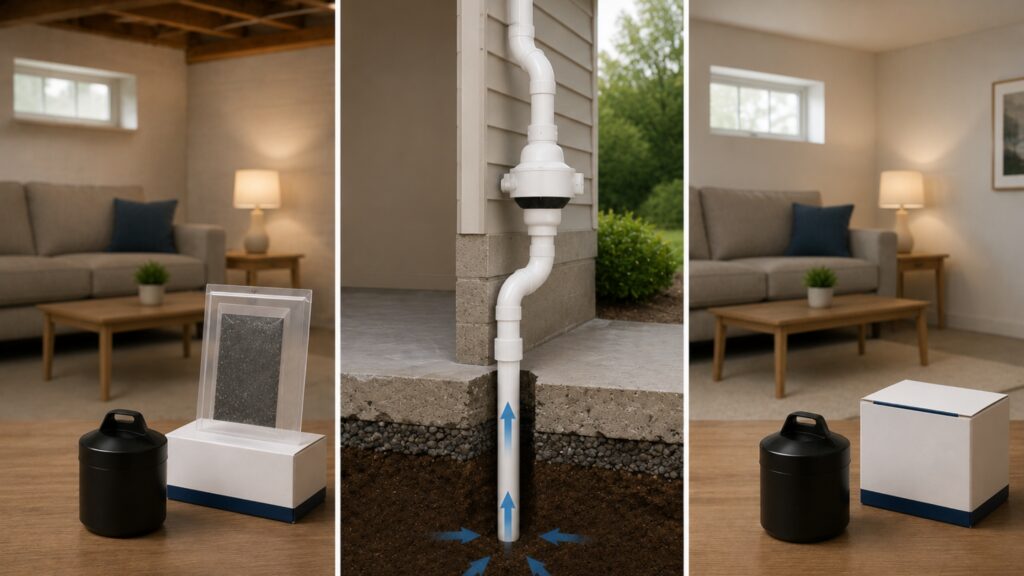
Radon testing falls into two categories: short-term tests (2–90 days) and long-term tests (90 days to one year). Short-term tests using charcoal canisters are the fastest way to identify whether your home exceeds the EPA action level of 4 pCi/L. Long-term alpha track detectors provide a more accurate picture of your annual average exposure.
The Iowa State University Extension Radon Program recommends that all Iowa homeowners test their lowest livable level, even if that floor is not regularly occupied. For post-mitigation verification, a short-term test placed in the same location as the pre-mitigation test gives the clearest before-and-after comparison. The IDPH advises retesting every two years after mitigation, or immediately following any major renovation that affects the foundation or HVAC system.
Test kits are available through the Iowa State University Extension office, many hardware stores, and directly from NRPP-certified testing laboratories. Results from a certified lab carry more weight than consumer-grade digital monitors for real estate transactions and insurance purposes.
FAQs
1. How much does radon mitigation cost in Des Moines, Iowa?
Radon mitigation in Des Moines typically costs between $800 and $2,500. Most homeowners with a standard poured-concrete basement pay around $1,200 for a single-point sub-slab depressurization system. Crawl space encapsulation and block wall systems cost more due to additional labor.
2. What radon level requires mitigation in Iowa?
The EPA action level is 4 pCi/L. At or above this level, the EPA and Iowa Department of Public Health recommend installing a mitigation system. Iowa State University Extension also advises considering mitigation for levels between 2 and 4 pCi/L, given Iowa’s elevated baseline radon environment.
3. How long does radon mitigation take in a Des Moines home?
Most Des Moines radon mitigation installations are completed in one day, typically four to eight hours. Complex foundations with multiple suction points or difficult pipe routing may require a second visit, but single-day completion is standard.
4. Is Iowa a high-radon state?
Yes. Iowa is one of the highest-radon states in the U.S. Approximately 71% of Iowa homes tested by the IDPH exceed the EPA action level of 4 pCi/L. Polk County, which includes Des Moines, holds an EPA Zone 1 designation — the highest risk category.
5. How do I find a certified radon contractor in Iowa?
Search the National Radon Proficiency Program (NRPP) directory at nrpp.info to find contractors with verified credentials. Cross-reference with the Iowa Department of Public Health radon page for any state-specific guidance. Always request proof of current certification before hiring.
6. Does radon mitigation really work?
Yes. Sub-slab depressurization systems reduce indoor radon levels by 50% to 99% in most homes, according to the EPA. The vast majority of Des Moines homes that install a properly designed SSD system test below 4 pCi/L after installation. Post-mitigation testing confirms the result.
7. How soon should I retest after radon mitigation?
Wait at least 24 hours after installation before placing a test device — 48 hours is recommended for the most reliable short-term result. The IDPH advises retesting every two years thereafter, or immediately after any renovation affecting the foundation or ventilation system.
Radon Mitigation Service Area: Greater Des Moines Metro
DSM Radon installs and services radon mitigation systems throughout Polk, Dallas, and Warren counties. Because Polk County sits in EPA Zone 1 — the highest radon-potential category — every community we serve shares the same elevated risk profile:
- Des Moines
- West Des Moines
- Ankeny
- Urbandale
- Johnston
- Waukee
- Clive
- Grimes
- Altoona
- Pleasant Hill
- Norwalk
- Indianola
Not sure if your address is covered? Reach out — if you are within about 45 minutes of Des Moines, we can almost certainly help.
Ready to Fix the Radon Problem in Your Des Moines Home?
Get a free, no-obligation estimate from licensed local radon professionals. Most systems are installed in a single day, with post-mitigation testing to confirm your levels are down. Prefer to talk it through? Call (515) 210-4407.